
Psychrometric Chart
Learn psychrometry with our interactive chart!
Understanding psychrometry and psychrometric conditions in water damage restoration is important so we can check how much drying equipment we need, whether we have a balanced drying system, and make sure we don’t get secondary damage! Use the interactive psychrometric chart below to see any ambient conditions.
What is Psychrometry?
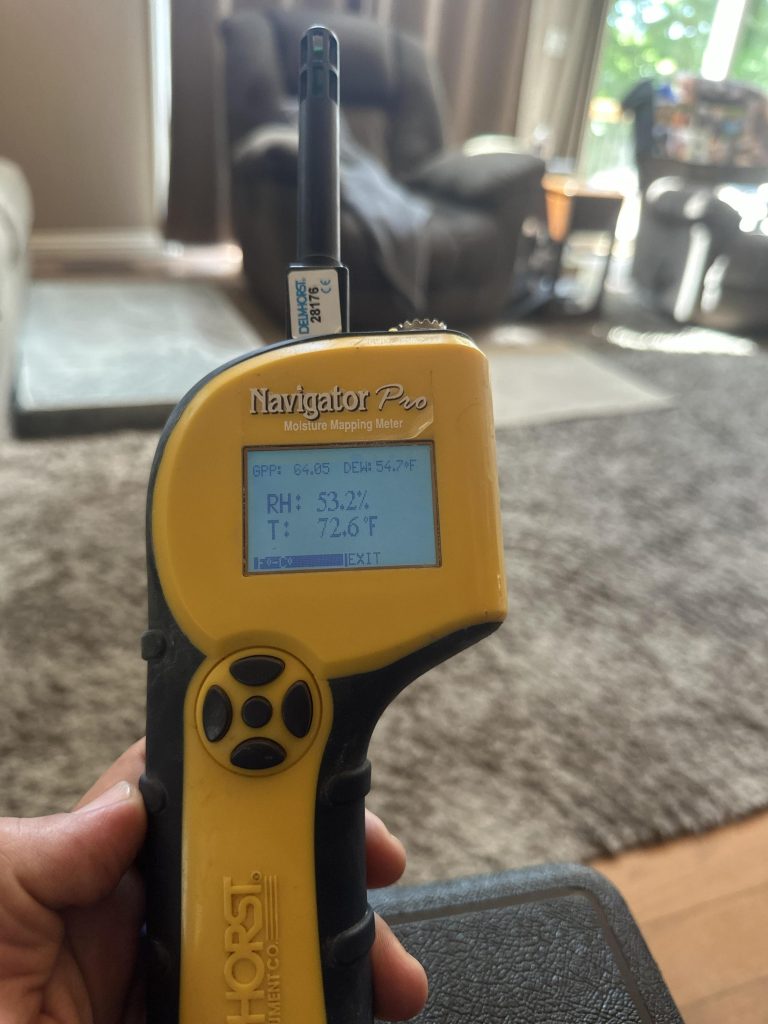
A Thermo-Hygrometer is used to measure psychrometric conditions. In this photo, the Moisture Meter has a Thermo-Hygrometer built in, so it measures and calculates the ambient air conditions.
Psychrometry is the study of humidity mixed with dry air. We often refer to this as the science of drying. In other words, this is how water vapor (gas) interacts with the air, which is an integral part of implementing the drying process! If you want to learn more about psychrometry and the psychrometric chart, we discuss them in detail in our Water Restoration Technician (WRT) class.
There are four main psychrometric conditions we need to know during a water damage restoration project (although there are many more). These include Temperature, Relative Humidity, Dew Point Temperature, Vapor Pressure, and Humidity Ratio (also known as Grains Per Pound/GPP). Each of these tells us information about the ambient air conditions that we can use to ensure our equipment is working properly, ensure we have favorable drying conditions, and help us determine what drying system to use.
Each of these psychrometric properties is used to determine the other properties. For example, if we have the Temperature (dry bulb) and the GPP, we can determine the Dew Point Temperature and Vapor Pressure by using the psychrometric chart.
Psychrometry and Water Damage
Psychrometry is an important part of a water damage restoration project. It helps in several ways:
- Understanding initial ambient conditions – When first arriving on the project, the psychrometric conditions help us determine immediate steps that need to be taken. This may include opening windows if the temperature needs to be increased or if secondary damage is likely to occur. When we have the ambient air conditions, we can make important decisions to mitigate further damage and start the drying project.
- Continuously Monitoring Ambient Conditions – A restoration project should be monitored each day, including the ambient air conditions. This will ensure we have a balanced drying environment, if we need to add additional equipment, or if we need to adjust anything else in our drying plan of Humidity, airflow, and Temperature.
- Ensure drying equipment is working – A dehumidifier’s job is to remove water vapor from the air. This does two things for our restoration project: 1) it removes humidity and ensures we don’t have secondary damage, and 2) it helps reduce vapor pressure in the air, contributing to more favorable drying conditions. As a bonus, dehumidifiers exhaust warm, dry air, which also contributes to drying!
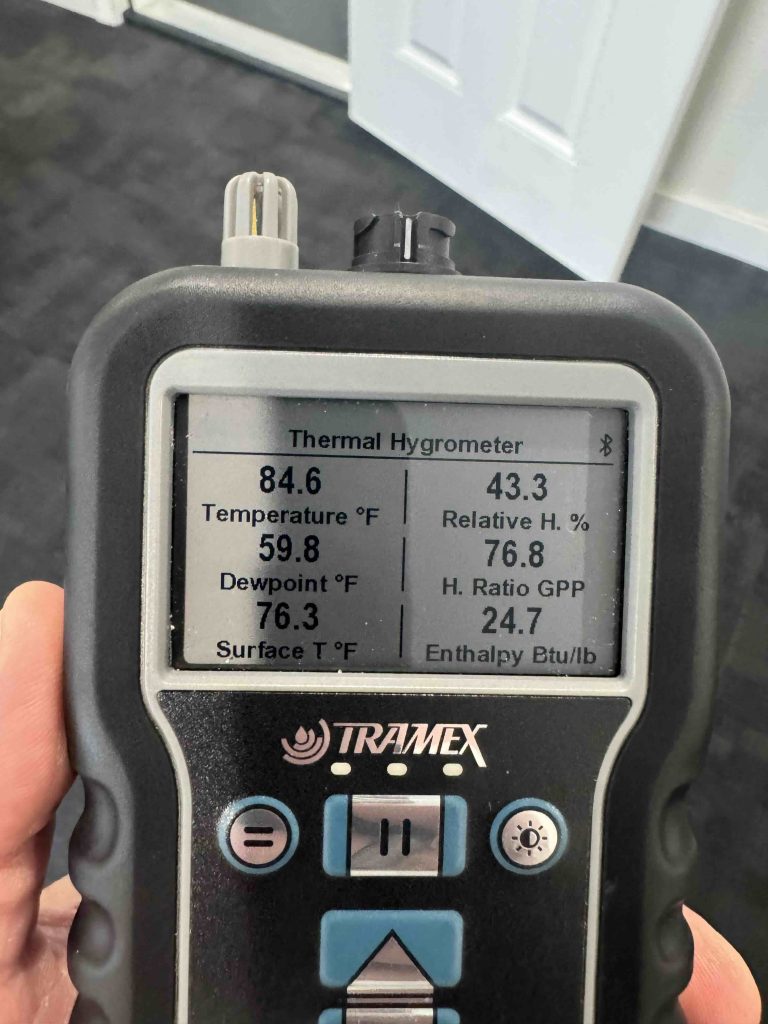
Psychrometric Terms
Dry Bulb Temperature
The dry bulb temperature is the temperature of the ambient air or what you would see on a thermometer. We refer to this simply as temperature.
Relative Humidity
Relative Humidity (RH) is how much water vapor is in the air, as a comparison or percentage of how much moisture the air can hold at a certain temperature or how full the air is compared to capacity.
Humidity Ratio (GPP)
The humidity ratio is the actual amount of water vapor in the air, measured as a ratio of the weight of the water vapor compared to the weight of the other elements of the air (e.g., oxygen, nitrogen). Humidity Ratio is also referred to as GPP (Grains per Pound) because we measure the grains (weight) of the water vapor per pound of dry air.
Dew Point Temperature
Dew point temperature occurs when the air reaches 100% relative humidity for a given temperature. When a surface temperature is at OR below dew point temperature, condensation can occur on that material.
Vapor Pressure
Vapor pressure, simply put, is the pressure of the air or vapor (e.g., oxygen, nitrogen, humidity) on the surrounding surfaces.
Learn about psychrometry with LearnToRestore.com
Learn how to use the psychrometric chart and apply psychrometry to water damage restoration projects!
